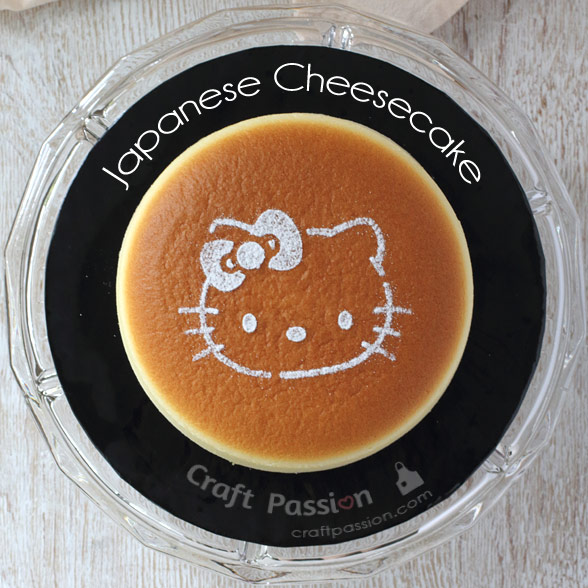
Kalau ada sesiapa di luar sana yang masih tercari-cari resepi Japanese Cheese Cake, boleh try resepi ini. Bahan-bahan mudah, dan senang je nak buatnya. Ada video tutorial dibawah boleh tengok cara membuatnya dengan lebih tepat. Kek ni memang favourite foreverlah !!
Japanese Cheesecake
Makes 8″ round cake pan | Prep Time: 30 mins | Bake Time: 78 mins
Recipe adapted from I Eat I Shoot I Post
INGREDIENTS:
Cream cheese batter
250 gram Philadelphia cream cheese
6 egg yolks
70 gram castor sugar (This is half of the total 140 gram)
60 gram unsalted butter
100 ml full cream milk
1 Tbsp lemon juice
2 tsp lemon zest
60 gram cake flour / superfine flour
20 gram corn starch
1/4 tsp salt
Meringue
6 egg whites
1/4 tsp cream of tartar
70 gram castor sugar (This is half of the total 140 gram)
video tutorial
METHOD:
- Pre-heat oven to 200°C / 392°F (Top and bottom heat, no fan force)
- Grease 8″ x 3″ cake pan with butter, line bottom with baking paper
- Whisk cream cheese till smooth over a warm water bath
- Add yolks and whisk
- Add half the sugar (70 gram) and whisk
- Warm milk and butter in microwave (high, 1 min) or stove, whisk into batter
- Add salt, lemon juice, lemon zest and whisk
- Remove from water bath, sift cake flour and corn starch and fold into mixture
- Whisk whites at low speed till foamy
- Add cream of tartar and beat at high speed till bubbles become very small but still visible
- Gradually add the balance 70 gram of sugar and beat till soft peaks
- Fold whites into batter 1/3 at a time
- Pour into cake pan and tap the pan on the counter to release air bubbles
- Bake with water bath on the bottommost rack in a preheated 200°C /
392°F for 18 mins, then lower to 140°C / 284°F for another 30 mins (let
the heat in the oven to drop gradually with door closed) and turn off
the oven and leave cake in the closed oven for another 30 mins. Remove
water bath and open the door of the oven slightly at the end of the
baking for another 30 mins for cake to cool.
COOK’S NOTE:
- Egg – Size: large. I separate the yolk and white by using cold egg.
By the time you’ve finished preparing the cream cheese batter, the egg
whites are just nice to beat into meringue.
- Cream Cheese – I used Philadelphia through out all my Japanese
cheesecakes, hence, I am not sure how other brands of cream cheese work
for this recipe.
- Sugar – you may reduce the sugar to 120g in total if you prefer to
reduce some calories intake. Caster sugar is slightly finer than fine
granulated sugar, if you cannot find caster sugar, lightly grind your
fine granulated sugar to break them smaller. Do not use powdered sugar
as it contained corn starch.
- Cake pan – I recommend that you use a 3″ tall non-black round cake pan of 8″ (may be this cake pan
is a good fit, found in Amazon). If you cannot find a 3″ high cake pan,
then replace it with a 9″ round cake pan with at least 2.5″ tall. Use a
1-piece punch out cake pan, not springform pan or any other seamed pan.
- Grease & Pan Lining – grease the side of the pan with butter and
line only the bottom of the pan. Do not line the side of the pan, it
will cause a crumple side. This is because when the cake shrink, it will
drag the paper down and cause the crease.
- Batter – the cream cheese batter after adding flours and before folding into meringue should be a little warm, about 40-50 °C.
- Meringue folding *** VERY IMPORTANT *** – folding
egg white meringue to cream cheese batter needs to be gentle to minimize
the deflation of tiny pockets of air in the meringue. Make sure both
batter and egg whites are well incorporated and come together.
- Batter filling – only fill Japanese cheesecake batter about 15mm
(1/2″) from rim, if you have extra batter (it shouldn’t be a lot left),
discard it.
- Water bath- Use a roasting pan of about 2″ high and at least 11″
diameter. Place a small towel on it to act as a thin insulation for the
cake pan so that the bottom is well protected from direct heat. Fill hot
water to about 1″ high after placing the cake pan on the roasting pan
and send into the oven.
- Oven – this is crucial and very important. The temperature stated in
the recipe is in-oven temperature. Each oven is different so if you are
not too sure if the temperature inside your oven is accurate as what
you have set at the control panel, get an oven thermometer
to check. The brand of my oven is Electrolux (model EOB307X-1), it is
measured with 10 °C shy, so I have to set 10 °C higher at my control
panel in order to get the required baking temperature.
- Cool down – After the cool down period with door closed for 30 mins,
I open the oven door to remove the water bath, put the cake back into
the oven and open the oven just a tiny bit (about 10mm). I use a mitten
to stop the door from closing back. Removing water bath is optional but I
find that it will prevent the bottom of the cake being wet by the
condensation. *Note: if you want a jiggling cake and do not bother to
have a cake with wrinkle top and sides, you may take the cake out
without having sitting for this extra 30 mins cool down time.*
- Unmold cake – The cake pan should be able to handle by bare hand
after cooling off in the oven with door slightly open for 30 mins. Use a
cake board to cover the cake pan, invert the pan and carefully remove
the pan. Remove the bottom liner and place another cake board or plate
on the bottom of the cake, invert it back. The cake should be soft and
fluffy and jiggly when it is still warm. Leave it to cool before sending
it into the fridge. The final cake size after shrinkage is about 7.5″ x
3″ (highest point)
- Cake serving – Decorate the top with snow powder or icing sugar. Cut
the cake with warm knife, wipe the knife clean before the next cut.